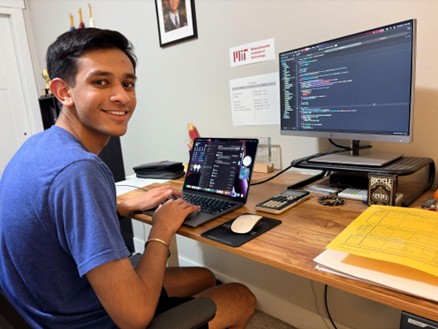
Ansh is a high school sophomore with strong interests in STEM, particularly physics and computer science. He enjoys working on hands-on projects including coding projects and physics labs that deepen his understanding of scientific concepts.
Outside of school, Ansh is a competitive table tennis player who participates in tournaments. He also plays the piano and enjoys reading science fiction and mystery books in his free time. He often spends time with his younger brother, engaging in activities together.
Ansh is passionate about using STEM to solve emerging problems and is committed to building his STEM identity through innovative technology and meaningful projects.
Q1: Describe your motivation for joining mySTEM.
Since a young age, I’ve been interested in STEM. In elementary and middle school, I did well on math and science tests, which first sparked my interest in the field.
As I got into high school, I realized I wasn’t really making an impact with the skills I had or fully applying my STEM interests anywhere. That’s when I came across mySTEM. It felt like the perfect opportunity to apply my skills in a community service–focused way and create real impact while using my knowledge and interests.
Q2: Describe your mySTEM Action Plan in detail. How did you choose this particular topic in your project?
My Action Plan, if I had to describe it in one sentence, is an app that helps users understand their medical reports by using AI to generate clear, simple summaries.
I came up with this idea after noticing a real problem in my own family. A few months to a year ago, I saw my grandma struggling to read her medical reports, and even my dad was sometimes confused by the medical language. I realized that medical reports often contain a lot of jargon, complex terminology, numbers, and labels that can be difficult for patients to understand.
That’s when I decided to create an app where a user can scan their medical report and have it processed by AI, which then produces a concise and easy-to-understand summary of their health information.
One important feature I focused on is privacy. Since medical reports contain sensitive personal information, the app automatically redacts private details, covering them with black boxes, before anything is processed, ensuring user data stays secure.
I also integrated multiple languages into the app so it can be accessible globally, especially for users who may not be fluent in English. This allows the app to support a wider community and increase its impact.
Another key idea behind the app is addressing the gap between receiving medical reports and getting a doctor’s explanation, which can sometimes take time and cause stress for patients. The app provides an initial, simplified understanding of the report so users can feel more informed and less anxious.
The app is not meant to replace doctors; it simply serves as a supportive tool that helps patients better understand their health information before they receive a full medical diagnosis.
Q3: In what ways has your mySTEM mentor contributed to the development and successful completion of your Action Plan? What are some ways that you feel like mentors and other scholars were able to help you succeed?
Sid, my mentor, has been especially helpful throughout this process. He works in the computer science and technology field, so he has been able to provide professional feedback on my app, including guidance on its features, technical improvements, and how to refine it overall. He also helped me think through how to publicize the app and the steps needed to ensure it can reach users and have real impact, rather than just remaining on my own devices.
I am currently in the process of working toward making the app more public and accessible. I’ve also received strong support from Gina and Kellie and other mySTEM leaders, who help organize events, connect mentors with students, and maintain strong communication across the program. Their coordination has made the overall experience very structured and supportive.
At this stage, the app is functional, but there are still many improvements I want to make, including enhancing the AI and adding additional features. I’ve had my parents and a few family friends test it out, which has provided helpful early feedback. While it has already had some impact, I’m continuing to develop it with the goal of reaching and helping many more users.
Q4: What measurable impact have you already observed as a result of your efforts? What are your aspirations for the future of your project?
Beyond my personal connections, I’m working on involving more people to help develop additional features for the app and ultimately get it published on the App Store so it can be used by a wider audience. That is one of my main future goals, making the app publicly accessible and scalable.
One feature I’m considering adding is a more holistic patient overview. This would allow users to input relevant medical history and context so that when the AI summarizes a specific report, it can do so with a better understanding of the user as a whole, rather than analyzing a single document in isolation.
There are still technical improvements I want to make, but overall my focus is on expanding the app’s functionality, improving the AI, and increasing its impact through publishing and outreach.
Q5: Do you believe that your participation in the mySTEM program has facilitated the growth of your STEM identity?
The mySTEM program has definitely helped me apply the skills, interests, and knowledge I already had in a meaningful way, while also connecting me more closely to the community and exposing me to different areas of STEM.
Before mySTEM, I had never 3D printed or laser cut anything, so it was really exciting to experience the more hands-on, physical side of STEM beyond just math and coding. Overall, it has broadened my understanding of STEM and helped me explore it in a more well-rounded way.
